

In Latin, the name translates to “sails like a vessel,” though the Ancient Greeks had given it the title ναυτῐ́λος (pronounced nautílos), deriving from the word for sailor or seaman.
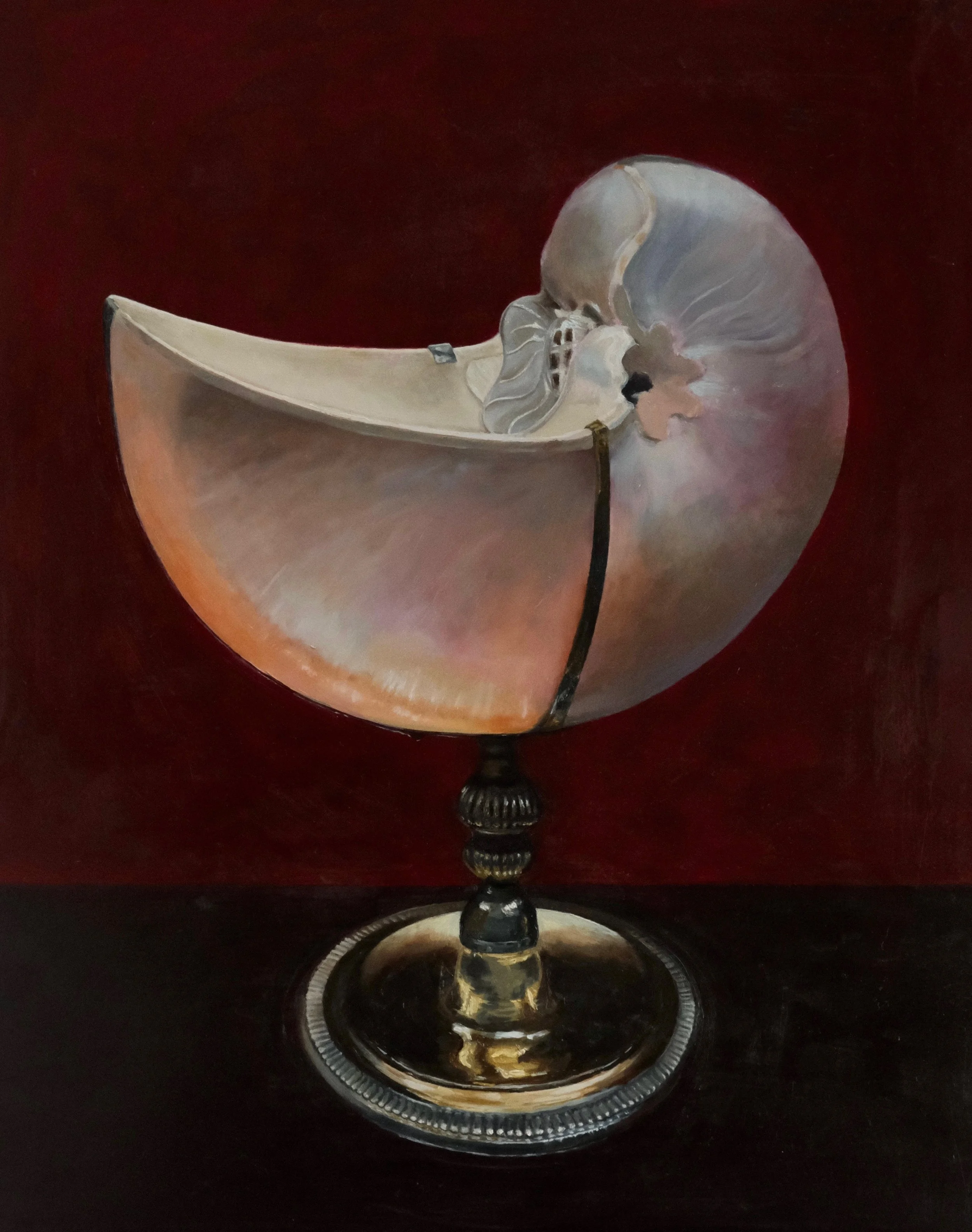
Inside their shells, the nautilus hides a series of successive chambers. Looking at a cross-section, you will see that these chambers divide up the inner-most part of the creature, leaving just the body chamber open. You will also, no doubt, recognize the cross-section of their shells as an illustration of the Fibonacci sequence. The sequence, originally discovered long before Fibonacci in India by Acharya Pingala, was highly influential to the artists of the Italian Renaissance (think Leonardo), particularly with relation to the Golden Ratio. These mathematical phenomena have helped shape Western art for the last 500 years.
Yet the nautilus did not just inspire artists…it became an object of art itself.
Kunstkammer
During the late Renaissance, with increased trade and exploration across the globe, wealthy individuals began collecting specimens of naturalia (natural wonders). Objects like “unicorn” horns (tusks from narwhals), exotic plants, and species of coral or shells could be found in these kunstkabinette.
Sailor (Nautilus)
2025-2026
oil on panel
40.6 × 50.8 cm (16 × 20 inches)
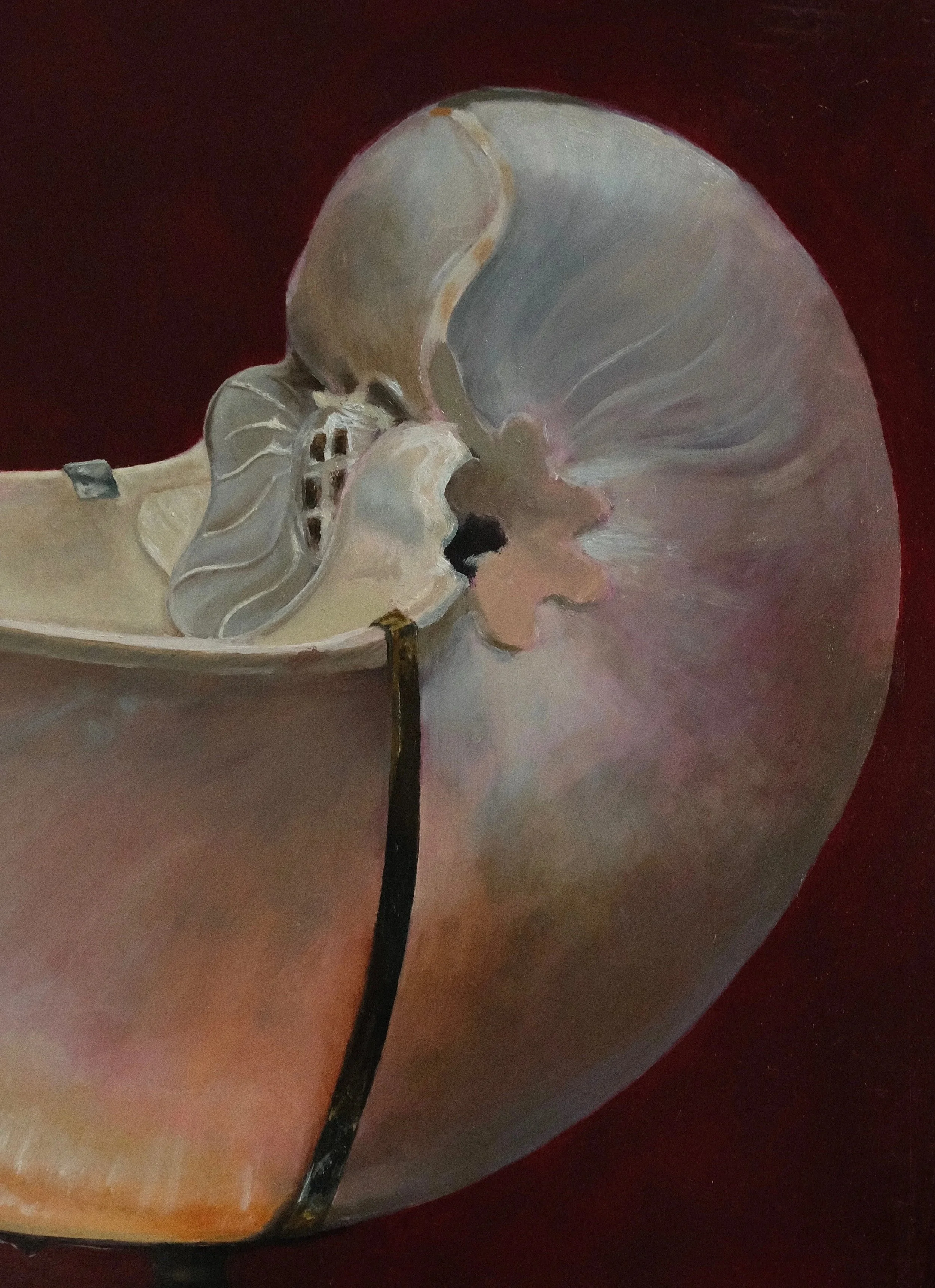
For collectors, the nautilus shell was a rarity not just because it had to be transported thousands of miles, but also because the creature was rather elusive, living well below the surface. The Dutch East India Company was one of the first European organizations to exploit the local population’s ability to source nautilus shells and transport them to The Dutch Republic. The shells that were displayed in their natural form, with their tiger stripes ranging in vibrancy from burnt umber to bright orange, evoked for the Europeans a sense of great sea voyages and of far-flung places where only the best of their sailors could go.
The nautilus shell that inspired this painting is found in the Kunstgewerbemuseum in Berlin. It comes from a group of three, carved with vines and engraved with insects, all attributed to Jean Bellekin. They are relatively simple compared to the ultra-ornate creations of Jan and Cornelius, yet they are fascinating and beautiful nonetheless. The shell depicted in this painting, without the insects and engraved vine, attempts to return it to a more original state, one in which the colors of the inner pearlescent layer can be appreciated. Not simply a reproduction of a work by the Bellekin dynasty, but a glimpse at the “blank canvas” these artists were working with. Perhaps, if you look long enough, you will imagine how Jean began to map out the creeping of the vine and the placement of the dragonflies and moths. Perhaps it will also remind you of the sea, of exploring this beautiful and strange planet, of the miracle of life and evolution, and even of the human impact.
For the full description of this painting, please inquire.